


‘When our lit chambers
face, we watch the sun drop evenings behind the steeple,
hangover Amherst woods whisking dark, stagger
nightfall — bliss-blued drunk.’
Rosa Lane imagines two women. They look out their windows at dusk, by kerosene lamp or moonlight. From the second floor, they can see above the low bush between their houses.
In her poems she feels them as ardent and sad, close and out of place, and she invokes pleasure in a glimpse of fire.
In her newest book, she honors Emily Dickinson, and Lane will speak her own words aloud on a spring night. Poets are coming together, as Brooklyn theater company Compagnia de’ Colombari and Tupelo Press meet at the Clark Art Institute to celebrate an infinite variety of voices in this country, with Walt Whitman as a catalyst.

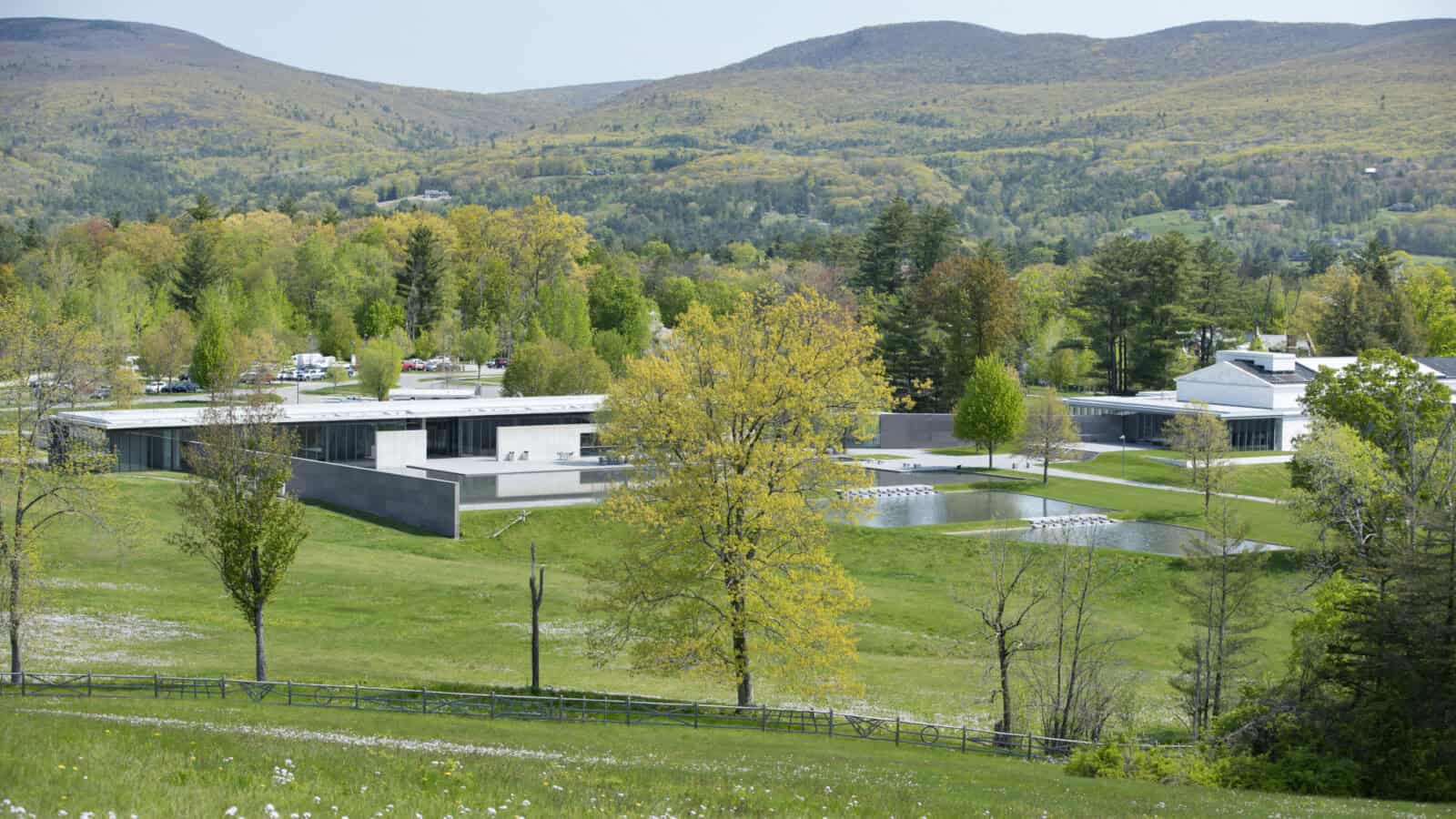
Wildflowers bloom on Stone Hill with the Clark Art Institute in the distance. Press photo courtesy of the museum
‘For every atom belonging to me as good belongs to you. … my tongue, every atom of my blood, form’d from this soil, this air …’
In an ongoing series, Colombari is growing community gatherings of voices, said Cindy Sibilsky, touring, PR communications manager, and a Broadway, Off-Broadway and international independent producer — and they are international, transatlantic, transnational, and all across America.
They began in the pandemic, she said. The theater had opened a new work to honor Whitman’s 200th birthday, and in 2020, when performances paused, they channeled that show into into seven films with 50 performers. When live performances became possible again, they took the idea to the streets.
They hope to bring together performers around the world, she said, “of every gender, race, age, background, language … that makes the self multitudes by its very nature.”

Two visitors sit beside the reflecting pool at the Clark Art Institute. Press photo courtesy of the Clark Art Institute
Some poets and artists come with sweeping anger and need, some warm and gentle, some deeply intimate.
“One poet in New York in Harlem is talking to Whitman as if he was a Nuyorican in the 21st century,” she said. “And another from Philadelphia says, “Oh, Whitman, my queer brother” as the opening line.”
Will Schmenner, head of public programs at the Clark, sees him as relational, moving across time and space with an open curiosity.
“Whitman had the chutzpah, the swagger, the charm to walk into almost any room and meet people,” he said, walking from mountain campfires to the Brooklyn docks — people doing hands-on work, boatmen and clam-diggers round the chowder-kettle.

Obie awardwinning actor John Douglas Thompson, shown here at Shakespeare & Company in Lenox, created one of the first Whitman on Walls films. Press photo courtesy of Shakespeare & Company.
Tupelo poet Karla Kelsey imagines Mina Loy walking through cobblestone alleys — “Mina steps with the quietude of Paris 1931 before dawn to walk ten minutes home down rue du Cherche-Midi from Constantin Brâncuși’s Impasse Ronsin atelier. Commanding the self to unruffle the mind and listen to the sparrows. To what day says … delivery trucks and cafés setting out tables …”
‘That’s really what this is about … the infinite variety of these responses of Americans today, who may be immigrants, who may be first generation, who may be fourth, fifth, 20th generation and everything in between. So it’s exciting to get to hear these responses from the communities around America.’ — Cindy Sibilsky
At the Clark, she and Lane will join poets J. Mae Barizo, KB Kinkel, Jennifer Militello, Chard deNiord and Allyson Paty.
Colombari has given them an open-ended invitation, Schmenner said. Loosely given prompts or themes, they can explore as they choose.
An their contemporary words, the afternoon can become an invocation and affirmation humanity, said Jeffrey Levine, founder artistic director and publisher of Tupelo press.
He hears an expansive empathy in Whitman and a generous understanding of the body, of nature and sensory stimuli — a language to say ‘every part of my body is beautiful, and every part of my experience is beautiful.’
Sibilsky finds compelling themes and contradictions in Whitman’s work, places that can rasp on the raw, and moments of humanity alongside a pounding of the chest great ego.


Rosa Lane’s collection of poems Called Back sparks inspiration from Emily Dickinson and her old friend, her lifelong love, Susan Huntington. Press photos courtesy of the artist

Actor Michael Potts performs in Whitman on Walls in Syracuse, N.Y. Photo courtesy of Compagnia de’ Colombari
As these performances have grown, she said, she has talked with poets, artists and musicians who have seen a reflection of many of their identities in his lines — and those who have made independent spaces in these performances, to affirm their senses of themselves in their own ways.
Lane in her poem reflects on her upbringing in northern Maine, Levine said, her experiences growing up queer in a small rural town, and her rejection of the attitudes that her family had for.
In her newest book, Called Back Lane finds a banked heat in the letters Emily Dickinson wrote to her old friend, her lifelong love, Susan Huntington. They became sisters-in-law and neighbors — and they held a close conversation for many years that still lives on paper. Drawing on Emily’s words, Lane imagines more she might have written.
‘Again, my dawn
wakes ruby — I rebel & dissent.’
Schmenner welcomed the chance of Emily’s presence in the evening and her freedom in finely wrought and generative mystery. And Sibilsky warmly recalled Emily’s advocates in conversations around WoW. Ahmad Almallah, a professor and a Palestinian poet from University of Pennsylvania, told her Whitman took too much away from Emily Dickinson, and he felt Emily deserved her due.

Berkshire poet KB Kinkel, a contributing writer to Tupelo Press, reads from their work at the Clark Art Institute. Press photo courtesy of the artist
“The project isn’t meant to be glorifying Whitman,” she said. “It’s meant to be a catalyst for the poets of today to respond to themes about America.”
She wants to bring these convergences to all 50 states, she said — Texas and Arkansas and Alabama and Florida — always created with partners in the community.
Soon after the show here, she will travel to talk with a group of Native writers and artists in San Francisco, she said, and she is reaching out to Native artists across the country. She has invited Opalanietet, founder of one of the only theater companies held and run by Lenni Lenape artists and makers on Lenni Lanape land.
At the Beinecke Library at Yale, Charmont Little, poet laureate of New Haven, will gather poets in a poetry slam, have them pull themes out of hat that night and choose a work or improvise.
Among the artists she has met in the past two years, and the work she has seen, Sibilsky recalls music for flute and a letter between Jose Perez, a writer and artist who has experienced the foster systems and incarceration. He was writing to his mother, who was at Rikers as the same time he was.
Poets speak in many languages — Spanish, Italian. A trans artist from Staten Island talks about their grandmother, who came from Napoli.
“And that’s really what this is about,” she said “… the infinite variety of these responses of Americans today, who may be immigrants, who may be first generation, who may be fourth, fifth, 20th generation and everything in between. So it’s exciting to get to hear these responses from the communities around America.”
‘They hold a freedom to be who you are — and get out into the world the way you want to. No one else can tell you who you are.’ — Will Schmenner
As an observer, she acknowledged, Whitman can be expansive and limited. One of the themes of the evening the poets have on offer is contradictions.
He calls viscerally to root of washed sweet-flag, pond-snipe, moose and the turkey hens — and at the same time he praises whaleboats and duck shooters and people wielding axes and mauls.
He offers a recognition of the lived experiences of working people, people living enslaved, native people as the land that sustains them falls to the hands of men with splitting mauls, women. And some of his language can read as stereotypical and belittling.
Levine sees a humanism in Whitman, and a growing commitment to abolitionism.
“He served as a nurse in the Civil War,” Levine said, “and he wrote about ministering to troops and getting at the horrors of war through … what happens to humans in the course of a war.”
“The Civil War, of course, was extraordinarily damaging to lives, to people, to egos, to fundamentals of democracy. And here we are. Here we are again.”
Sibilsky imagines these events as an encouragement of real democracy and connection, human and living here together, in this time and place.
They hold a freedom to be who you are, Schmenner said — get out into the world the way you want to. No one else can tell you who you are.
“Even the ego of ‘I contain multitudes’ … we all do,” Sibilsky said. When poets translate into their own selves, the chant becomes, “ ‘you contain multitudes,’ and so does everybody else. And that’s giving them power.”
